
Metal Balers
Front-Out Y81Q Baler for Prepared Perforated Steel Sheet Scrap
Review perforation patterns, remaining ligaments and prepared sheet geometry
Assess prepared perforated steel sheet scrap for front-out baling, with pattern-specific preparation, snagging checks, clean sorting and documented acceptance.
PRODUCT VIDEO
Front-Out Y81Q Baler for Prepared Perforated Steel Sheet Scrap video
01 / PRODUCT DESCRIPTION
Product Overview
Purpose, machine structure and its role in the recycling process.
Assess the remaining sheet structure, not just the holes
Perforated sheet offcuts retain a connected metal structure despite their open area. A wide border, narrow ligaments between holes and an unperforated end section can exist in the same piece. The Front-Out Y81Q Baler for Prepared Perforated Steel Sheet Scrap addresses the evaluation of these prepared production remnants. Its Y81Q title is not a verified model designation supported by the workbook; configuration values below remain front-out series references requiring confirmation.
The application is different from a batch of solid sheet and from loose punchings collected under a perforating line. Hole pattern, remaining metal, sheet thickness and piece shape all help describe the material. A high open-area percentage does not by itself establish easy compression or a suitable machine. Start with samples representing the actual patterns and borders produced at the site.
02 / MATERIALS & OUTPUT
Applications & Materials
Suitable scrap materials, industries and operating scenarios.
Make the preparation boundary explicit
Record the steel grade, original sheet thickness, overall offcut size and perforation pattern. Include pieces with solid margins, interrupted patterns, formed returns or damaged sections if these occur in normal collection. Photographs should show both the overall geometry and a close view of hole edges. Describing only the nominal hole diameter can miss the continuous strips of metal that connect the piece.
For this enquiry, prepared means inspected and brought within an agreed material and size envelope before loading. It does not mean that any perforated sheet becomes suitable after a quick visual check. Obtain supplier approval for the required preparation and identify who releases each container. Separate expanded metal, wire mesh and loose punchings unless those streams are specifically evaluated; they are not interchangeable with connected perforated sheet.
Check for sharp broken ligaments, projecting tabs and pieces hooked together. Material that catches on a container edge or lifts as an unexpected cluster needs a handling review. Do not pull snagged material through a loading opening by hand. Remove unsuitable attachments through an approved upstream process, and exclude sealed objects, batteries, pressurized items, hot scrap and material with unknown residues.
Keep different alloys identifiable and describe paint, plating, oil or moisture to the supplier and buyer. If the same collection area receives both steel and nonferrous perforated sheet, use the separate-batch guidance to plan identification and changeover rather than assuming the visible hole pattern identifies the metal.
03 / STRUCTURE & FEATURES
Equipment features.
Features & Benefits
Operational advantages and configuration benefits for buyers.
Evaluate loading interaction and forward collection
The front-out concept establishes a proposed discharge direction, while hydraulic compression remains subject to approval for the actual feed. Ask for the selected machine drawings and loading instructions before matching a prepared piece to a chamber. An offcut that fits by length and width may still have projecting edges or an awkward nested form that affects the approved loading method.
Discuss how prepared sheets move from their collection container to the chamber. Perforations and torn edges can create snag points, so the supplier should assess representative handling conditions rather than only a neatly stacked display sample. Do not assume the machine includes a de-nesting device, a feeding conveyor or a shredder. Any such equipment would require a separate specification and review.
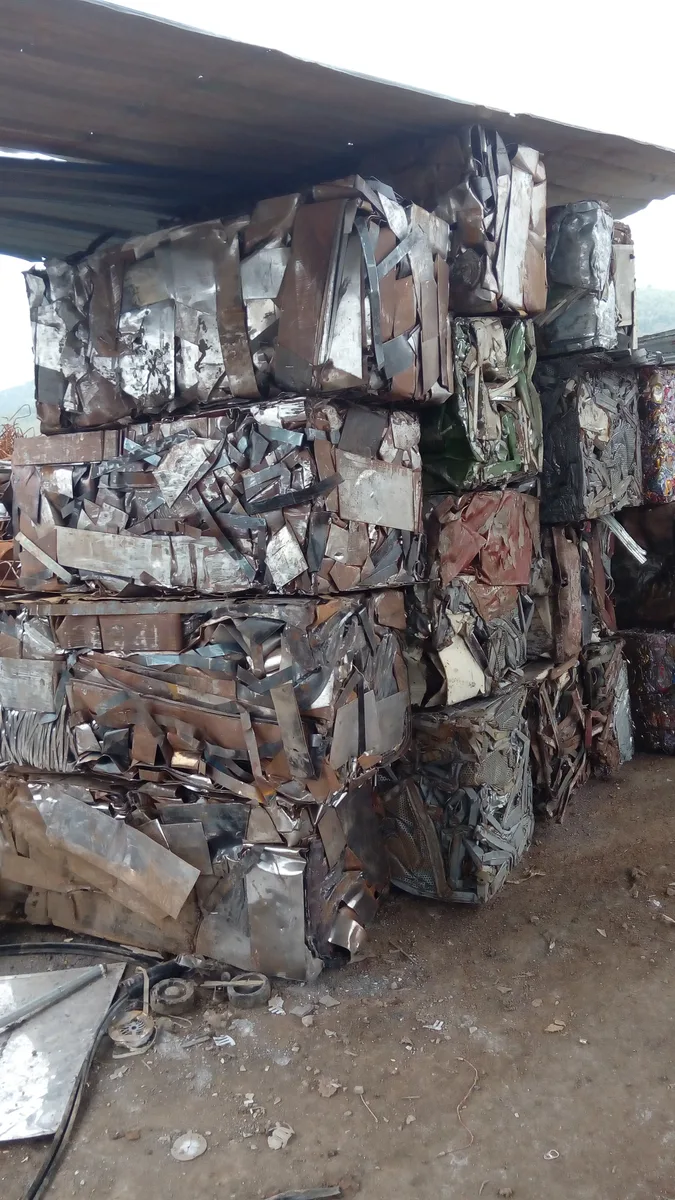
At the forward collection position, inspect the produced bale under the agreed acceptance method for projecting edges, loose fragments and the buyer's handling requirements. Perforations do not create certified lifting points, and a bale should not be lifted by hooking through a visible hole. Confirm the permitted receiving and lifting method for the delivered machine and actual bale.
04 / WORKING PRINCIPLE
Operation & Maintenance
Practical guidance for safe operation and routine maintenance.
Test the range of patterns that production creates
Build an evaluation set around the real pattern families, solid-border proportions and normal damage conditions. Keep a record of preparation, contamination and any separately removed punchings. Compare the results against agreed requirements for loading, compression, discharge and downstream acceptance. The aim is to define a usable material envelope, not to prove every perforated steel product suitable from one successful sample.
Document which changes require another review. New tooling may create a different ligament width or a larger solid border even when the sheet grade and thickness remain unchanged. Changes in coating, formed edges or collection method can also alter the practical feed. Keep rejected or unassessed material visibly separate so it does not re-enter the approved stream.
Use the machine-specific operating procedure and the site's approved handling arrangements. Stop and isolate before clearing a jam, removing caught fragments or entering restricted areas. Where an output target is needed, measure the complete agreed workflow with representative material; the series no-load cycle reference does not quantify production with perforated sheet.
05 / TECHNICAL REFERENCE
Technical Parameters
Key selection data and model-dependent specification ranges.
Configuration references for the enquiry
The six attributes below are drawn from the supplied front-out series information in the HBQ sheet. They are reference choices for discussion, not a verified Y81Q model specification. Confirm each selected attribute against the proposed Y81Q machine, its drawings and the order. The HBQ series name is not being renamed as a Y81Q model.
Keep full series ranges intact when comparing quotations. Do not combine their endpoints into a new machine size or infer production from a no-load cycle. Final acceptance should use the actual material and agreed operating conditions. Ask for the machine-specific manual, layout and configuration list before approving the installation.
Front-Out Baler Reference Video is the designated equipment/process reference. It is not proof that this exact material or configuration was tested, and does not establish a production rate.
| Attribute | Reference value |
|---|---|
| Discharge arrangement | Forward push-out |
| Wear plate alternatives | NM450 or Hardox450; confirm specified alternative |
| Series chamber length | 800–2,000 mm; confirm matched chamber dimensions |
| Listed PLC option | Siemens; confirm the ordered control configuration |
| Listed motor configuration | Taizhou Taida; confirm order specification |
| Listed pump configuration | JiangSu Hengyuan; confirm order specification |
06 / SOLUTIONS & CUSTOMER CASES
Plan the complete process.
RELATED NEWS
News & buying guides
APPLICATIONS
Material preparation guides
These are related material guides. Follow each guide’s feedstock limits; a related material is not automatically approved for every machine configuration.
07 / QUESTIONS & SUPPORT
Product questions,
answered.
Delivery, Service & FAQ
Delivery scope, technical support and frequently asked questions.
Frequently asked questions
Are perforated sheet, expanded metal and wire mesh equivalent feeds?
No. Their connected structures and handling behavior differ. Identify each material separately and obtain explicit approval rather than carrying acceptance from one stream to another.
What does prepared perforated scrap mean here?
It means inspected material meeting an agreed size, condition and preparation envelope. It does not establish a universal cutting size or authorize loading an unassessed piece.
Can loose punchings be included with the perforated skeletons?
Only if their inclusion has been reviewed. Record loose punchings separately because they change the material description and may affect handling and downstream acceptance.
How should steel and nonferrous perforated sheets be separated?
Identify the alloy at collection and maintain batch identity. The batch-changeover guidance provides a planning reference.
Can a forklift collect the finished bale?
Confirm the actual bale and approved lifting arrangement. Review the forward-end pickup interface; a discharge direction alone does not establish fork access.
Does the open-area percentage determine machine suitability?
No. Supply thickness, grade, pattern, ligaments, solid borders and piece geometry. The selected machine and representative prepared material must be assessed together.
Equipment Recommendation
Tell Us About Your Material and Capacity
Share the key operating conditions below so our team can compare suitable equipment and prepare a practical configuration.