
Metal Balers
Side-Push Light Metal Scrap Baler
Light Scrap Baling: Bulk Condition and Controlled Loading
The HBT side-push baler can be selected for suitable prepared light-gauge metal scrap. Review the loose bulk condition, maximum piece geometry and loading method before defining the configuration and receiving bale.
PRODUCT VIDEO
Side-Push Light Metal Scrap Baler video
01 / PRODUCT DESCRIPTION
Light Scrap Baling: Bulk Condition and Controlled Loading
Application selection for the existing HBT side-push family.
Light Scrap Baling: Bulk Condition and Controlled Loading
The HBT side-push baler can be selected for suitable prepared light-gauge metal scrap. Review the loose bulk condition, maximum piece geometry and loading method before defining the configuration and receiving bale.
A Side-Push Light Metal Scrap Baler addresses a handling problem: suitable thin or bulky scrap can occupy considerable collection space before it is compressed. The HBT horizontal hydraulic arrangement compacts an approved charge and discharges the bale sideways. Selection should account for the way the incoming scrap occupies the chamber, not simply its name or the weight of one sample.
Here, light scrap means suitable prepared light-gauge or low-bulk-density metal forms. It is not a claim that every low-density metal, alloy or object is acceptable. Thin ferrous offcuts, aluminum pieces and other separately approved streams have different preparation and downstream requirements. Magnesium, unidentified alloys, powders and hazardous articles are not brought into scope by the word light.
The central purchasing question is how a bulky, variable charge will be inspected, presented and collected safely during ordinary work. The HBT family overview explains the side-push arrangement; this application guide concentrates on the loose feed condition and its consequences for the surrounding workflow.
02 / MATERIALS & OUTPUT
Define the Prepared Material Streams
Keep material identification and preparation separate from compaction.
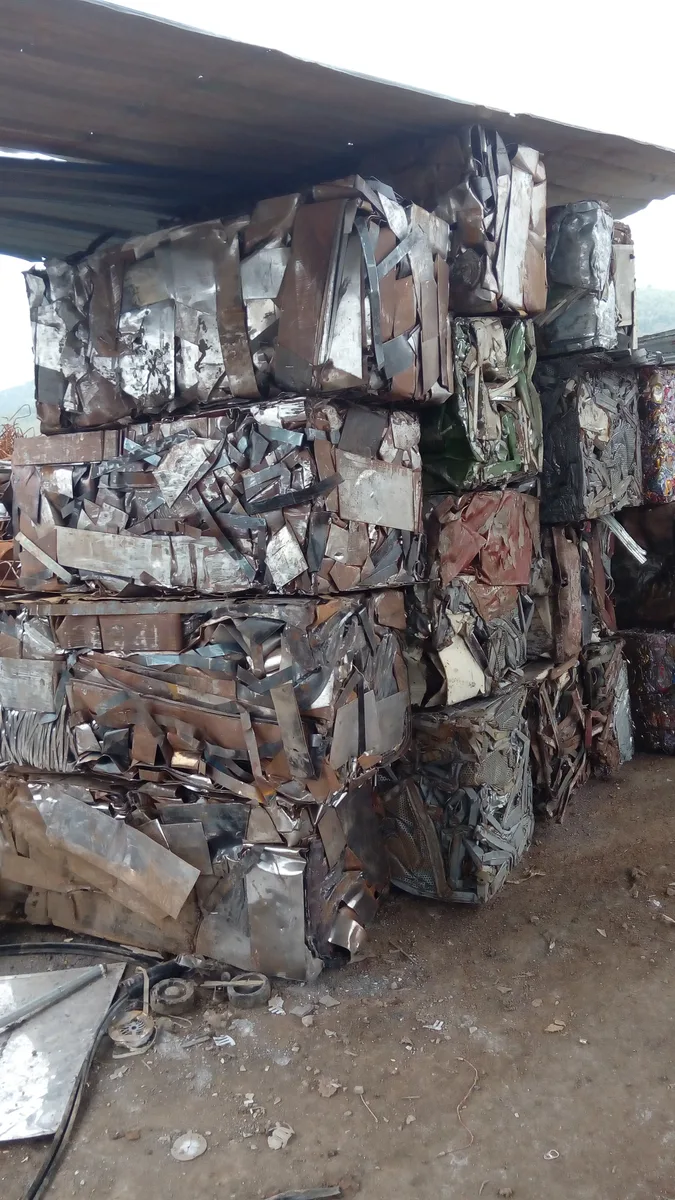
Describe the actual material before choosing a loading plan. Record its metal grade where known, typical shape, largest dimensions and the change between a loosely filled container and settled material. Photographs should include the normal bin and a few of the most awkward pieces. A close-up of clean metal alone does not show how folded sheets, curled strips or interlocked offcuts behave as a charge.
- Separate ferrous and nonferrous grades according to the agreed recycling specification.
- Identify sharp edges, long strips, nested pieces and parts that can bridge across a container.
- Review coatings, attached plastics, oil and moisture before approving the feed.
- Exclude batteries, sealed vessels, pressurized containers and unidentified hazardous items.
The four material pictures are separate library examples for application review, not a recipe for mixing metals. A photograph does not establish a permissible thickness, a minimum bulk density or an hourly output. Discuss metal turnings, fine particles and dense cast pieces as different applications rather than adding them to a light-scrap plan by assumption.
The four material photographs show loose light ferrous sheet and formed offcuts, aluminum sheet pieces, aluminum profile offcuts, and loose stainless utensils or formed scrap. These are separate material streams, each subject to its own preparation and configuration review, not an instruction to bale them together.
04 / WORKING PRINCIPLE
Plan the Handling Workflow
Define people, equipment and the side-discharge interface.
Arrange collection so that a bulky load can be presented within the approved charging envelope without people entering hazardous areas. Decide where oversized or entangled pieces will be prepared and where rejected items will be held. Do not use a person to push protruding material below a closure or to correct a load while machine parts can move.
Loading and bale removal can occupy as much attention as compression when incoming scrap is irregular. State whether the planned feed is handled manually or with suitable handling equipment, and ask how that arrangement fits the selected configuration. Full-automatic and semi-automatic control options do not remove the need to define material inspection, loading and supervision.
Provide a clear lateral receiving area for side discharge. Consider protruding edges and recovery in shape when choosing collection equipment and a safe lifting method. Keep walking routes outside the discharge zone. Follow the supplied instructions for guards, emergency stops and hydraulic inspection, and isolate the equipment before maintenance or clearing an obstruction. Never guide a moving bale by hand.
05 / TECHNICAL REFERENCE
Selected HBT Technical Attributes
Five supported reference attributes, not a fabricated model rating.
These attributes describe the HBT side-push equipment family. Options and site-specific arrangements must be confirmed in the selected technical configuration.
| Technical attribute | HBT reference |
|---|---|
| Drive type | Hydraulic |
| Machine layout | Horizontal |
| Model series | HBT |
| Motor voltage | Configured for the installation electrical supply |
| Bale discharge | Side push-out |
Force, chamber dimensions, bale weight and production rate are not inferred from a material title. Confirm those values against representative feedstock and the agreed machine configuration.
Operating options: full-automatic or semi-automatic, as confirmed by Dershan. The technical proposal defines the controlled actions and operator responsibilities. The option name does not establish automatic feeding, automatic sorting, unattended operation or a guaranteed production rate.
Configuration and Acceptance Review
Specify representative feed and the conditions to be checked.
Ask for a configuration review using representative feed rather than a single convenient demonstration charge. Include normal light scrap, an awkward but intended batch and the preparation needed before each can be loaded. Record how material arrives, the time needed to make it ready and the way each finished bale will be removed. Those observations help define an acceptance plan; they are not presented here as completed test results.
State the receiving buyer's requirements for material segregation, contamination and package handling. A visibly compact bale is not proof of a particular density or acceptance grade. Pressing force, chamber dimensions, motor power and output must come from the chosen machine configuration and agreed feed, not from the description light scrap.
For a more narrowly defined stream, use the sheet-metal scrap guide or the aluminum can guide. These pages address different preparation questions. Send your feed photographs, maximum piece dimensions, site supply, collection arrangement and daily material pattern through the Dershan contact page.
06 / SOLUTIONS & CUSTOMER CASES
Plan the complete process.
RELATED NEWS
News & buying guides
Buying a Scrap Metal Baler: What to Include in Your RFQ
A useful scrap metal baler quotation starts with representative scrap, the buyer’s bale specification and a complete handling plan. Use this checklist to compare proposals on the same basis.
Read details ↗Scrap Metal Baler Throughput: How to Plan Real Production
Plan baler capacity around saleable output per working hour, including loading and discharge. A nominal press cycle is only one part of the production picture.
Read details ↗CUSTOMER CASES
Related project references
Each reference identifies its own equipment and project scope; it is not a test record for every material on this product page.

APPLICATIONS
Material preparation guides
These are related material guides. Follow each guide’s feedstock limits; a related material is not automatically approved for every machine configuration.
07 / QUESTIONS & SUPPORT
Product questions,
answered.
Side-Push Light Metal Scrap Baler FAQ
Practical answers for this application.
Does light metal scrap mean aluminum only?
No. This page uses light scrap to describe suitable prepared light-gauge or bulky forms. Identify the actual metal and grade separately; the description does not approve every lightweight alloy. See the light-gauge ferrous scrap guide for a steel-specific example.
Can bulky scrap be loaded without preparation?
Only when it fits the approved charging envelope and handling procedure. Long, nested or interlocked pieces may require separate preparation before the charge is accepted.
Can I infer output from the weight of one container?
No. Loose bulk condition, preparation, loading, compression and collection all affect the working arrangement. Agree how representative batches will be assessed before relying on an output figure.
May workers push scrap down while the baler is moving?
No. Follow the supplied guarding and operating procedures. Do not reach into the chamber or correct a charge while movement is possible; use the approved isolation process for interventions.
Are full-automatic and semi-automatic options available?
Yes. Dershan has confirmed both operating options. The quotation must define the included actions and operator responsibilities; neither name alone means automatic loading or unattended operation.
What information is most useful for a light-scrap quotation?
Provide photographs of the filled collection bin and typical pieces, metal identification, maximum dimensions, contamination, daily variation, planned feeding equipment and the receiving buyer's requirements.
Equipment Recommendation
Tell Us About Your Material and Capacity
Share the key operating conditions below so our team can compare suitable equipment and prepare a practical configuration.