
Metal Balers
Side-Push Metal Baler for Rectangular Bales
Define Rectangular Bale Measurements and Handling Limits
Define Rectangular Bale Measurements and Handling Limits. Review the HBT configuration against the actual prepared scrap and site requirements.
PRODUCT VIDEO
Side-Push Metal Baler for Rectangular Bales video
01 / PRODUCT DESCRIPTION
Define Rectangular Bale Measurements and Handling Limits
A focused purchasing and operating decision for the existing HBT family.
Define Rectangular Bale Measurements and Handling Limits
Define Rectangular Bale Measurements and Handling Limits. Practical selection and acceptance guidance for the existing HBT side-push family.
A Side-Push Metal Baler for Rectangular Bales is selected when the intended receiver needs a defined compacted form that can be measured and handled consistently. The HBT arrangement uses hydraulic compression and side discharge for suitable prepared metal scrap. The word rectangular describes an external form; it does not prove an exact dimension, weight, density or stacking approval for every feed.
Start with the reason dimensions matter. A buyer may need a receiving envelope, a handling device may have a size restriction, or a storage plan may require an agreed footprint. Those conditions should be documented before the supplier selects the offered configuration. A photograph of a tidy bale cannot replace the dimensional requirements.
This guide concentrates on measurement and shape acceptance. For the broader equipment arrangement, see the HBT overview. No arbitrary bale size or adjustment range is promised on this page.
02 / MATERIALS & OUTPUT
Match the Shape Requirement to Prepared Feed
Match the Shape Requirement to Prepared Feed.
Identify the actual material and preparation before discussing the finished outline. Thin sheet, profile offcuts, wire and other suitable streams may have different springback, protrusion and handling behavior. The supplier must review the representative feed, not only the requested rectangular drawing.
Separate the nominal body dimensions from unacceptable projections or loose pieces. The buyer and equipment supplier should agree which observations matter and how they are measured. A dimension written in a catalog is not evidence that every irregular scrap batch will have perfectly flat faces or identical corners.
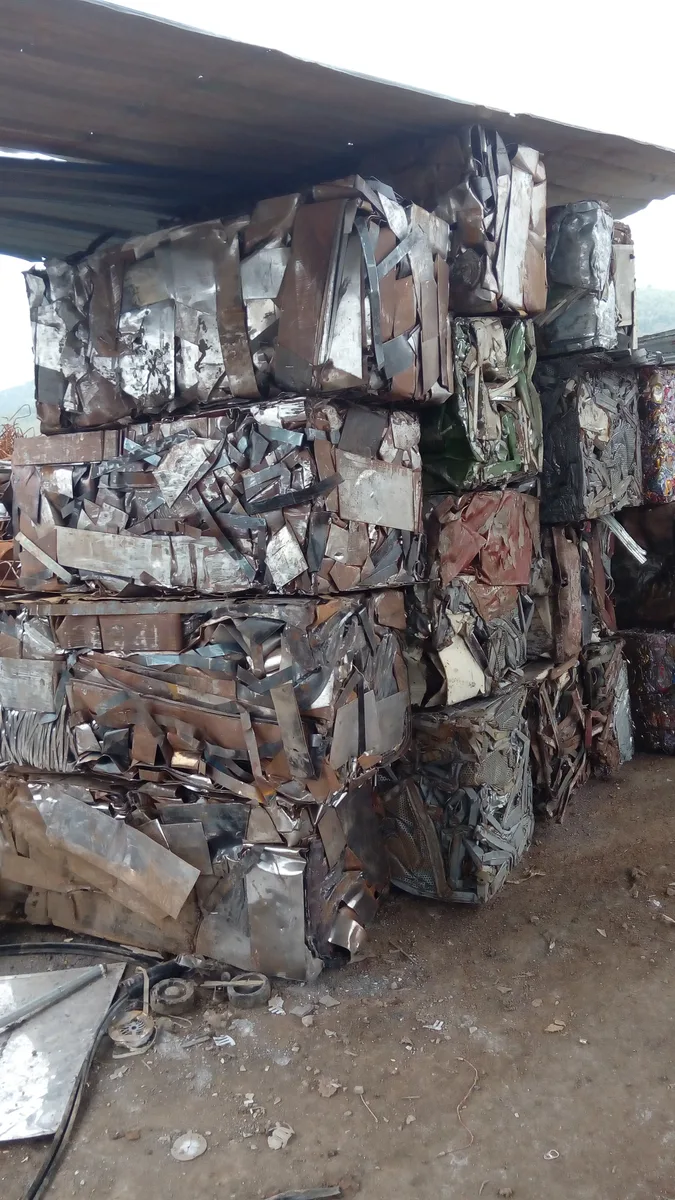
Keep contamination and grade acceptance independent of shape. A bale can look rectangular while containing the wrong alloy or unwanted attachments. Use the appropriate material checks before compression and retain lot identification afterward. The pictures illustrate possible material forms, not dimensional certificates or results for the particular configuration being proposed.
04 / WORKING PRINCIPLE
Agree a Practical Measurement Record
Agree a Practical Measurement Record.
Define the measurement points, units and stage of observation before a trial. Specify whether the requirement concerns a nominal body size or the overall external envelope, and how protrusions are recorded. The responsible parties should choose a safe method that does not require personnel to enter an active discharge or handling area.
Record the configuration, feed lot and preparation alongside the measurements. If a receiver requires a tolerance, obtain that requirement in writing and confirm the supplier's proposal against it. Do not invent an industry-wide tolerance or silently treat one acceptable sample as proof that all batches will fall inside it.
Keep a photograph with the measurement record where useful, while recognizing its limits. Perspective, irregular edges and concealed surfaces can make a photo unsuitable for calculating dimensions. Measurements should use the agreed method, and a disputed result should remain identifiable rather than being replaced by a more attractive example.
05 / TECHNICAL REFERENCE
Selected HBT Technical Attributes
Five supported reference attributes, with configuration-dependent options stated separately.
These attributes describe the HBT side-push equipment family. Options and site-specific arrangements must be confirmed in the selected technical configuration.
| Technical attribute | HBT reference |
|---|---|
| Machine layout | Horizontal |
| Drive type | Hydraulic |
| Feeding arrangement | Manual or grabber, subject to the approved workflow |
| Motor voltage | Configured for the installation electrical supply |
| Bale discharge | Side push-out |
Force, chamber dimensions, bale weight and production rate are not inferred from a material title. Confirm those values against representative feedstock and the agreed machine configuration.
Operating options: full-automatic / semi-automatic, as confirmed by Dershan. The technical proposal defines the controlled actions and operator responsibilities. These option names do not establish automatic feeding, sorting, unattended operation or a guaranteed production rate.
Connect Dimensions to Safe Handling
Connect Dimensions to Safe Handling.
Review the lifting, receiving and storage arrangement using both the agreed dimensions and the actual load information. Rectangular appearance alone does not authorize stacking to a particular height or show that a lifting attachment is appropriate. Those decisions belong to the responsible handling and site plan.
Inspect the accepted bale condition at the agreed stage. If it changes during handling or storage, record the observation and review the approved feed and process with the supplier. Do not compensate for an unsuitable bale by improvising restraints or access to the machinery; use the agreed corrective procedure.
Maintain the machine in accordance with its manual, including hydraulic and protective-device checks. Shutdown and isolation are required before authorized access for maintenance or trapped material. Full-automatic and semi-automatic options do not eliminate the need to keep people clear during discharge, measurement and collection.
06 / SOLUTIONS & CUSTOMER CASES
Plan the complete process.
RELATED NEWS
News & buying guides
Buying a Scrap Metal Baler: What to Include in Your RFQ
A useful scrap metal baler quotation starts with representative scrap, the buyer’s bale specification and a complete handling plan. Use this checklist to compare proposals on the same basis.
Read details ↗Scrap Metal Baler Throughput: How to Plan Real Production
Plan baler capacity around saleable output per working hour, including loading and discharge. A nominal press cycle is only one part of the production picture.
Read details ↗CUSTOMER CASES
Related project references
Each reference identifies its own equipment and project scope; it is not a test record for every material on this product page.

APPLICATIONS
Material preparation guides
These are related material guides. Follow each guide’s feedstock limits; a related material is not automatically approved for every machine configuration.
07 / QUESTIONS & SUPPORT
Product questions,
answered.
Side-Push Metal Baler for Rectangular Bales FAQ
Answers specific to this selection decision.
Does rectangular mean all bales have identical dimensions?
No. The selected configuration and agreed feed conditions determine what can be offered. Obtain the relevant dimensions and acceptance conditions in the proposal rather than assuming an exact result from a descriptive shape term.
Should protruding scrap be included in a measurement?
Agree that with the intended receiver before testing. Distinguish the main bale body from its overall external envelope and record unwanted projections according to the acceptance method, rather than changing the method after a result is known.
Can dimensions be calculated from the website photographs?
No reliable dimensional specification should be derived that way. Perspective and hidden surfaces affect the image, and the photographed configuration may differ. Use the actual proposal and agreed physical measurements.
Does a rectangular bale automatically permit stacking?
No. Stability, load, handling equipment and site conditions require a separate assessment. This page does not approve a stacking height or imply that a regular outline guarantees safe storage.
What information makes a dimensional trial useful?
Record the identified configuration, prepared material, measurement method, units and observations. Include the receiver’s stated criteria and any departures from them, so the result can be interpreted without assuming unstated conditions.
Can a different size simply be selected later?
Do not assume unrestricted adjustment or conversion. Ask the supplier what the specific configuration supports and what changes would require a different arrangement. No universal custom-size capability is established here.
Equipment Recommendation
Tell Us About Your Material and Capacity
Share the key operating conditions below so our team can compare suitable equipment and prepare a practical configuration.