
Metal Balers
Side Turn-Out Stainless Steel Scrap Baler
Keep Stainless Grades Separate and Verify Bale Release
A Side Turn-Out Stainless Steel Scrap Baler is an HBF application for suitable prepared light stainless offcuts. Horizontal hydraulic compression forms the bale, and the turn-out mechanism releases it toward a side receiving area. Two selection questions deserve particular attention: whether the alloy lot remains identifiable, and whether the formed package is suitable for collection after release.
PRODUCT VIDEO
Side Turn-Out Stainless Steel Scrap Baler video
01 / PRODUCT DESCRIPTION
Keep Stainless Grades Separate and Verify Bale Release
Material preparation and side turn-out selection for the HBF family.
Keep Stainless Grades Separate and Verify Bale Release
Evaluate HBF stainless steel baling with traceable alloy lots, prepared light offcuts, springback review and safe side turn-out collection.
A Side Turn-Out Stainless Steel Scrap Baler is an HBF application for suitable prepared light stainless offcuts. Horizontal hydraulic compression forms the bale, and the turn-out mechanism releases it toward a side receiving area. Two selection questions deserve particular attention: whether the alloy lot remains identifiable, and whether the formed package is suitable for collection after release.
Stainless scrap should not be defined only by its shiny surface or its response to a magnet. The producer's records, the receiving specification and any required identification checks establish the material route. Baling consolidates the accepted stream but does not provide a substitute for those checks.
Use this guide with the HBF side turn-out machine overview. It provides a focused stainless workflow within the existing equipment family, not proof that every grade and section can use the same loading practice or achieve the same output.
02 / MATERIALS & OUTPUT
Define the Stainless Stream Before Loading
Define the accepted feed and its preparation.
Identify the source and declared grade of the stainless scrap. Sheet remnants, thin trim and stamping pieces can look similar while belonging to different purchased grades. Where the buyer needs composition verification, agree the required method and records. Magnetic response alone should not be used to certify every stainless alloy or approve a mixed batch.
Measure the longest pieces and their maximum section thickness. Curved or folded offcuts can occupy more space than their flat dimensions suggest, and interlocked skeletons may require preparation before a controlled charge can be made. Dense bars, heavy castings and assembled components are outside the light-offcut discussion unless separately approved.
Keep carbon-steel pieces and uncertain alloys out of a segregated stainless lot. Declare oils, coatings and attachments, and exclude hazardous or sealed items. The baler does not clean the scrap or certify its grade. Record preparation decisions at the collection stage rather than relying on a final bale label to correct an unknown mixture.
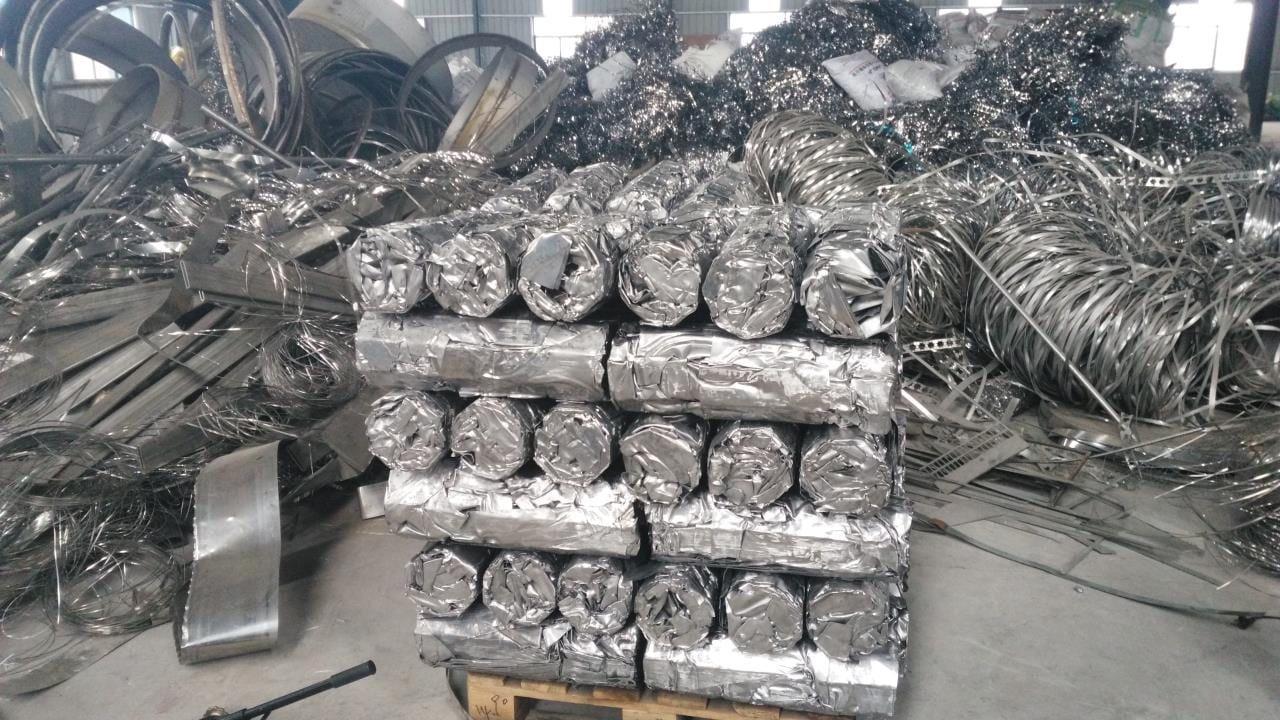
The material photographs illustrate forms for assessment rather than certify stainless grades or document an HBF test. Keep grade identification and preparation records separate from visual references, and do not infer a tested handling result from a pictured package.
04 / WORKING PRINCIPLE
Review Recovery of Shape After Turn-Out
Review the complete turn-out and collection arrangement.
The HBF compresses accepted feed inside the horizontal chamber and turns the bale into the side receiving arrangement. For stainless offcuts, inspect what happens after release rather than evaluating only the restrained package. Material form and recovery of shape can affect projecting edges and how the bale is collected.
Use the selected machine drawing to establish the discharge movement and the receiving zone. Nearby bins or handling equipment must not occupy that movement area. The collection plan should account for the actual package condition without workers approaching to hold loose strips or steady a bale during discharge.
During an agreed trial, observe the normal turn-out and removal sequence with representative prepared scrap. Record any released pieces, opening of the package or handling difficulty as specific findings. Do not turn a satisfactory result for one thin offcut stream into a universal statement about all stainless grades, thicknesses or shapes.
05 / TECHNICAL REFERENCE
Selected HBF Mechanical Attributes
Five sourced attributes; series references and options require configuration confirmation.
These five attributes are selected from the supplied HBF side turn-out series information. They describe family features or configuration choices, not a complete specification for one machine.
| Technical attribute | HBF reference |
|---|---|
| Bale discharge | Side turn-out |
| Core components | Pump and motor |
| Electrical supply phase | Three-phase |
| Wear plate | Replaceable |
| Structural steel plate | Q235B |
The selected configuration must be confirmed for the actual prepared scrap. A listed cross-section range does not include bale length or mean that every machine adjusts across the whole range. Force, output, power and bale weight are not inferred from the product title or photograph.
Control choices in the supplied information include PLC automatic or manual control; Dershan also confirms a semi-automatic option. Confirm the included actions and operator responsibilities in the proposal. These labels do not establish automatic loading, sorting or unattended operation.
Make Selection and Acceptance Specific
Agree selection evidence, acceptance and maintenance responsibilities.
Provide photographs that show the range of feed, not only the easiest pieces. Include source and grade records, thickness, maximum dimensions, preparation and the intended loading method. State how finished bales will be lifted, identified and stored, along with the receiving buyer's package and material requirements.
The mechanical proposal should identify the offered HBF configuration and the assumptions used for any production target. Sorting, preparation and bale collection belong in that assessment. A generic force or capacity range cannot establish performance for stainless scrap, and no fixed density or bale weight is promised here.
Inspect protective devices, hydraulic connections and wear components according to the delivered manual. Stop for qualified assessment if movement, leakage or guarding is abnormal. Cleaning and blockage removal require authorized isolation and stored-energy control. For a separate carbon-steel stream, consult the light steel guide rather than combining its acceptance conditions with stainless lots. Submit the final material and layout brief through Dershan's contact page.
The linked South Africa project is a turn-out layout and segregated-batch handling reference only; it is not a stainless-steel trial or a performance guarantee for this HBF configuration.
06 / SOLUTIONS & CUSTOMER CASES
Plan the complete process.
RELATED NEWS
News & buying guides
Buying a Scrap Metal Baler: What to Include in Your RFQ
A useful scrap metal baler quotation starts with representative scrap, the buyer’s bale specification and a complete handling plan. Use this checklist to compare proposals on the same basis.
Read details ↗Scrap Metal Baler Throughput: How to Plan Real Production
Plan baler capacity around saleable output per working hour, including loading and discharge. A nominal press cycle is only one part of the production picture.
Read details ↗CUSTOMER CASES
Related project references
Each reference identifies its own equipment and project scope; it is not a test record for every material on this product page.

APPLICATIONS
Material preparation guides
These are related material guides. Follow each guide’s feedstock limits; a related material is not automatically approved for every machine configuration.
07 / QUESTIONS & SUPPORT
Product questions,
answered.
Side Turn-Out Stainless Steel Scrap Baler FAQ
Practical answers for this material and discharge arrangement.
Does magnetic attraction identify the stainless grade?
Not reliably for every grade or condition. Use the source information and the receiving buyer’s required identification method. A magnetic observation alone does not establish complete alloy composition or lot acceptance.
Can stainless and carbon steel share one bale?
Only where the buyer explicitly permits the mixture. Otherwise segregate collection, preparation and finished storage. A baler cannot separate the metals once they have been compressed together.
Why consider springback during selection?
The package can behave differently after the restraint of the chamber is removed. Inspect projecting edges, released pieces and collection stability after the normal turn-out sequence using representative material.
Are thick stainless bars covered by this application?
No blanket approval is given. Dense or heavy sections need separate review of their dimensions and processing requirements. Keep them out of a plan established for light sheet and stamping offcuts.
What is a useful acceptance condition?
Define the material, preparation, finished package requirements and collection method before trial. Assess actual bales after release and handling, and record the conditions under which an acceptable result was demonstrated.
Can a series specification predict output for stainless?
Not by itself. The offered configuration and the actual feed and handling cycle must support the target. Ask for the assumptions behind any quoted rate rather than transferring a result from another material.
Equipment Recommendation
Tell Us About Your Material and Capacity
Share the key operating conditions below so our team can compare suitable equipment and prepare a practical configuration.