
Metal Balers
Side-Push Aluminum Profile Baler
Aluminum Profile Offcuts: Geometry, Alloy Separation and HBT Selection
An HBT side-push baler can be selected for suitable prepared aluminum profile offcuts. Review profile length, section geometry, attachments and alloy separation before defining the loading envelope and required bale.
PRODUCT VIDEO
Side-Push Aluminum Profile Baler video
01 / PRODUCT DESCRIPTION
Aluminum Profile Baling Overview
Application-specific selection within the existing HBT family.
Aluminum Profile Offcuts: Geometry, Alloy Separation and HBT Selection
An HBT side-push baler can be selected for suitable prepared aluminum profile offcuts. Review profile length, section geometry, attachments and alloy separation before defining the loading envelope and required bale.
A Side-Push Aluminum Profile Baler applies the HBT horizontal hydraulic arrangement to suitable prepared extrusion offcuts. The machine compresses an approved charge and pushes the finished bale sideways to a receiving position. This is an application of the existing HBT family, not a claim that the product title identifies a new machine model.
Profile scrap presents a different purchasing problem from a bin of cans or loose sheet. A short solid section, a thin hollow extrusion and a long window-frame offcut can occupy and load the chamber differently. Length alone does not describe that difference. Section dimensions, wall thickness, shape and attachments belong in the application information sent before quotation.
For an extrusion or fabrication workshop, a useful objective is an orderly route from segregated offcut collection to an accepted handling bale. Baling does not identify alloys or remove inserts. The general aluminum scrap guide covers broader streams; this page concentrates on profile geometry and the information needed to evaluate it.
02 / MATERIALS & OUTPUT
Identify and Prepare Profile Offcuts
Identify the feed and preserve separate material streams.
List the profiles generated by the operation rather than describing all of them as aluminum scrap. Record the longest pieces, the largest cross-section and the thickest portions, including junctions or reinforced areas. Photographs should show a scale and several typical pieces. Include awkward shapes and assembled offcuts, not only the simplest clean extrusion.
- Keep known alloy or source batches separate when the receiving buyer requires traceability.
- Identify hollow, open and solid sections and note whether pieces nest or interlock.
- Review steel screws, hinges, plastic thermal breaks, rubber and other attachments.
- Describe painted, anodized or otherwise coated material separately from clean production offcuts.
- Exclude sealed articles, batteries, free liquids and hazardous contamination.
Long or interlocked profiles may require preparation to fit the approved loading envelope. The required preparation method and final feed size must be established for the selected configuration. Do not assume that the baler is a substitute for a shear or that a closing surface may safely crop any protruding extrusion.
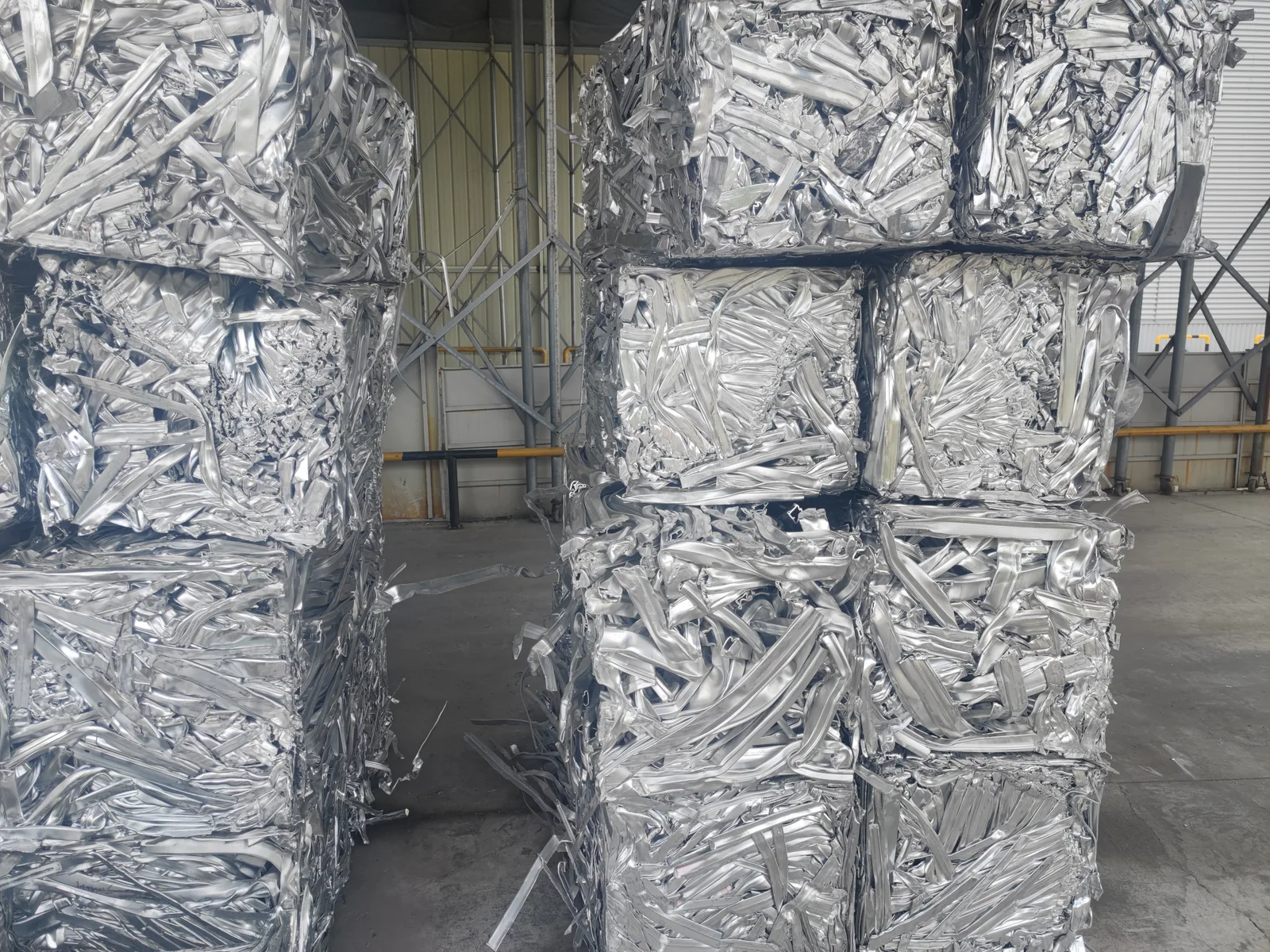
The material gallery shows loose profile offcuts, aluminum sheet and formed pieces, profile-scrap bales and mixed stacks of aluminum scrap and can bales. The bale photographs are library illustrations, not verified production results from this HBT configuration. Other aluminum forms require separate review and must not be mixed into a traceable profile lot by assumption.
04 / WORKING PRINCIPLE
Organize the Extrusion Scrap Workflow
Plan preparation, loading and lateral bale collection.
Plan collection at the saw, fabrication station or sorting area so that offcuts remain accessible without becoming an uncontrolled tangled pile. Use containers and handling arrangements appropriate to the actual lengths and sharp ends. The preparation area should have a defined place for rejected attachments and pieces that exceed the agreed feed limits.
Present an approved charge using the specified feeding arrangement. Keep all pieces inside the charging envelope and clear of closures. Follow the supplied operating sequence for compression and side discharge; the full-automatic or semi-automatic option does not change the need for suitable preparation and safe supervision.
Provide a clear lateral receiving route for each finished bale. Confirm how it will be supported, lifted and moved, considering protruding ends or recovery in shape after compression. Do not guide an emerging bale by hand. Isolate the equipment before cleaning, maintenance or obstruction removal, and follow the manufacturer's procedures for guards, stops and hydraulic-system inspection.
05 / TECHNICAL REFERENCE
Selected HBT Technical Attributes
Five supported attributes from the supplied HBT reference.
These attributes describe the HBT side-push equipment family. Options and site-specific arrangements must be confirmed in the selected technical configuration.
| Technical attribute | HBT reference |
|---|---|
| Drive type | Hydraulic |
| Machine layout | Horizontal |
| Bale discharge | Side push-out |
| Model series | HBT |
| Feeding arrangement | Manual or grabber, subject to the approved workflow |
Force, chamber dimensions, bale weight and production rate are not inferred from a material title. Confirm those values against representative feedstock and the agreed machine configuration.
Operating options: full-automatic or semi-automatic, as confirmed by Dershan. The selected technical proposal defines the controlled actions and operator responsibilities. Neither option name alone establishes automatic feeding, unattended operation or a guaranteed production rate.
Specify the Profile Application
Define the application before agreeing a configuration.
Build the enquiry around a small profile inventory. For each regular stream, provide its source, alloy identification where known, section drawing or clear photographs, maximum dimensions and typical attachment condition. Explain whether the stream is consistent through the day or changes when production switches to another extrusion.
Then describe the receiving buyer's requirements. These may concern alloy segregation, allowable foreign material, package dimensions and how the bale is unloaded. Do not assume that a compact appearance proves acceptable purity or a particular density. Agree how representative prepared profiles and the resulting bale will be assessed before accepting a numerical performance promise.
The HBT machine overview explains the side push-out arrangement. Chamber size, force, installed power and output belong to the matched configuration, not to the word profile. Include site voltage, loading equipment and available floor space when requesting that configuration.
Send the profile inventory and layout through the Dershan contact page. A useful proposal states the intended feed, preparation boundary, operating option and collection interface together, so that a change in profile geometry triggers a review rather than an unsupported assumption.
06 / SOLUTIONS & CUSTOMER CASES
Plan the complete process.
RELATED NEWS
News & buying guides
Buying a Scrap Metal Baler: What to Include in Your RFQ
A useful scrap metal baler quotation starts with representative scrap, the buyer’s bale specification and a complete handling plan. Use this checklist to compare proposals on the same basis.
Read details ↗Scrap Metal Baler Throughput: How to Plan Real Production
Plan baler capacity around saleable output per working hour, including loading and discharge. A nominal press cycle is only one part of the production picture.
Read details ↗CUSTOMER CASES
Related project references
Each reference identifies its own equipment and project scope; it is not a test record for every material on this product page.

APPLICATIONS
Material preparation guides
These are related material guides. Follow each guide’s feedstock limits; a related material is not automatically approved for every machine configuration.
07 / QUESTIONS & SUPPORT
Product questions,
answered.
Aluminum Profile Baler FAQ
Answers for this material and its handling requirements.
Can hollow and solid aluminum profiles use the same loading plan?
Not automatically. Their geometry and section thickness can differ substantially. Submit both types for review and use the feed limits agreed for the selected HBT configuration.
Must long profiles be shortened before baling?
They may need preparation to fit the approved charging envelope without bridging or protruding across closures. The necessary length is configuration-specific and is not stated as a universal limit here.
Can profiles containing thermal breaks or steel fittings be baled as clean aluminum?
Baling does not remove those materials. Identify the attachments and agree their removal or acceptance with the processing team and receiving buyer before defining the feed.
Should different extrusion alloys be mixed?
Keep them separate when the buyer requires alloy traceability. Compression is a handling process and cannot correct an incorrectly mixed batch.
Which operating options are available?
Dershan has confirmed full-automatic and semi-automatic options. The proposal defines the included actions, feeding arrangement and operator responsibilities; neither label alone means unattended operation.
What should an aluminum-profile enquiry include?
Send section photographs or drawings, maximum lengths and wall thicknesses, alloy or source details, coatings and attachments, daily volume, buyer requirements, site supply and the proposed loading and collection layout.
Equipment Recommendation
Tell Us About Your Material and Capacity
Share the key operating conditions below so our team can compare suitable equipment and prepare a practical configuration.