
Metal Balers
Side Turn-Out Aluminum Profile Baler
Prepare Profile Offcuts Without Losing Alloy Identity
A Side Turn-Out Aluminum Profile Baler is an HBF application for suitable prepared aluminum profile offcuts. Hydraulic compression consolidates the charge, and the formed bale is turned toward a side collection zone. Selecting the equipment requires attention to profile geometry, attachments and the stability of the released package.
PRODUCT VIDEO
Side Turn-Out Aluminum Profile Baler video
01 / PRODUCT DESCRIPTION
Prepare Profile Offcuts Without Losing Alloy Identity
Material preparation and side turn-out selection for the HBF family.
Prepare Profile Offcuts Without Losing Alloy Identity
Select HBF profile baling around section geometry, inserts, preparation and the condition of the package after side turn-out.
A Side Turn-Out Aluminum Profile Baler is an HBF application for suitable prepared aluminum profile offcuts. Hydraulic compression consolidates the charge, and the formed bale is turned toward a side collection zone. Selecting the equipment requires attention to profile geometry, attachments and the stability of the released package.
Profile scrap is not always a uniform clean material. New extrusion offcuts, coated fabrication trim and dismantled frames can differ in alloy information, residual fittings and preparation needs. The purchasing discussion should state which stream is actually intended rather than letting the word profile imply that every assembled section is ready for loading.
This focused guide builds on the HBF turn-out arrangement and the aluminum material overview. It describes a preparation and handling application within the family, not an additional machine model or an unrestricted dismantling capability.
02 / MATERIALS & OUTPUT
Inspect Profile Sections and Attachments
Define the accepted feed and its preparation.
Record profile length, section dimensions and wall thickness, including the largest exceptional pieces. A bundle of short cut ends behaves differently from long interlocked sections. Hollow shapes and projecting flanges can create a larger loading envelope than a simple length measurement suggests, so include views from more than one angle in the inquiry.
Identify steel screws, plastic thermal breaks, rubber seals and other attachments. Their presence affects both the preparation process and the buyer's acceptance decision. Baling does not remove these components. Agree which material can remain and which must be separated before loading, rather than presenting an assembled profile as clean aluminum by default.
Keep known alloys and coated or uncoated streams separate where the receiving specification requires it. Preparation should produce a controlled charge that fits the approved envelope without forcing long pieces across closing surfaces. Do not assume that the baler can substitute for every upstream cutting or dismantling operation.
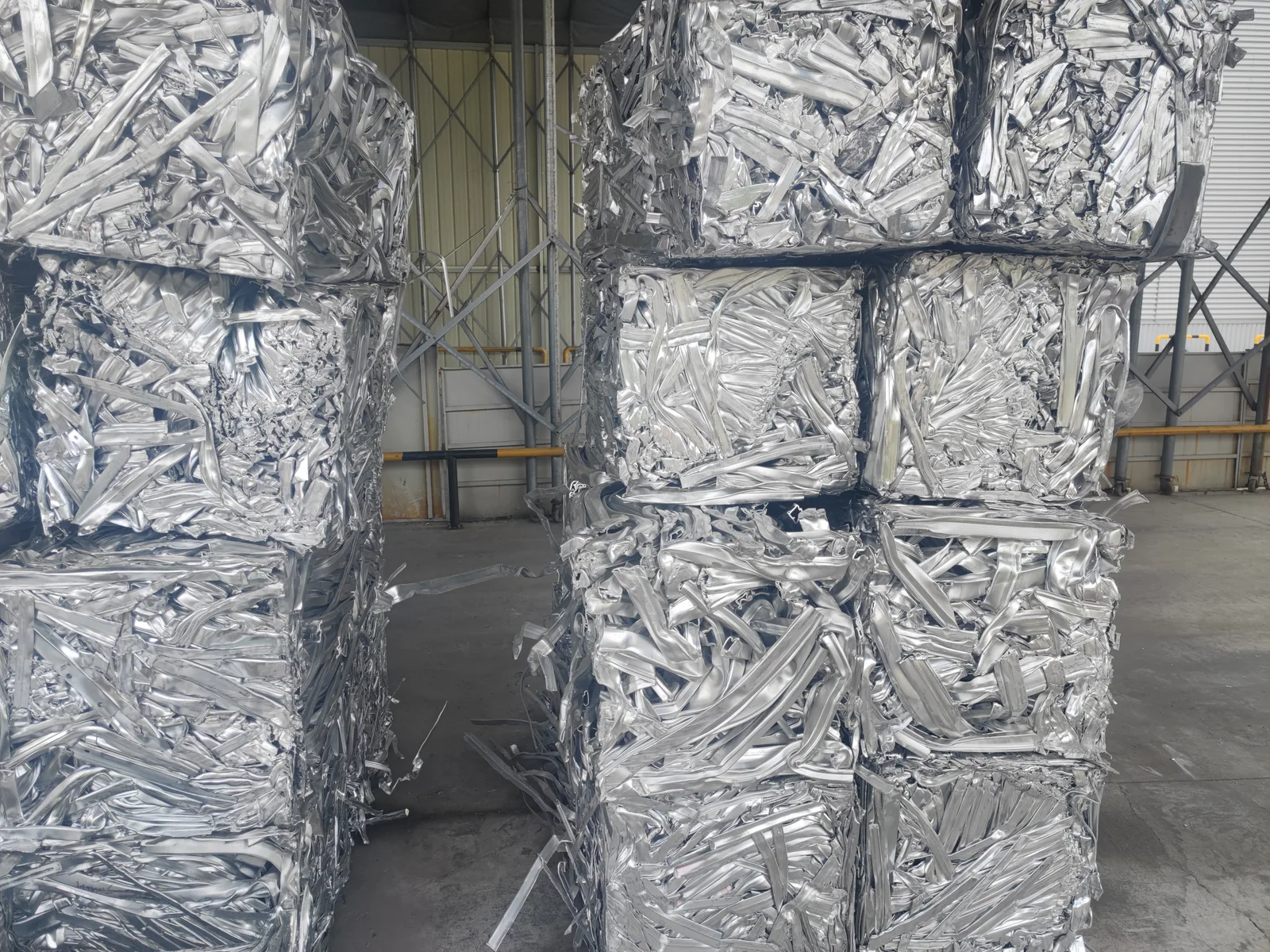
The material gallery includes profile and sheet reference forms and an illustrative finished aluminum bale. These are separate preparation or output references, not a required mixed charge or evidence of a profile trial on this HBF configuration.
04 / WORKING PRINCIPLE
Allow for Shape and Loose Pieces at Turn-Out
Review the complete turn-out and collection arrangement.
The prepared profile charge is compressed in the horizontal HBF chamber and turned toward the side receiving area. Confirm the discharge movement and receiving arrangement using the selected equipment drawing. Profile ends and exposed edges make it important to evaluate the released package rather than only the compressed form inside the machine.
During a representative trial, inspect whether sections remain contained through normal turn-out and collection. Record projecting ends, separated pieces and any change in the package that affects the handling equipment. The observation should cover the actual preparation and mixture proposed for production, not an unusually uniform demonstration charge.
Keep the complete receiving zone clear of bins, pedestrians and unrelated vehicle movement. Collection arrangements must not rely on a worker holding a profile in place during release. Any housekeeping or removal of trapped offcuts must follow the approved stop and isolation procedure before access is permitted.
05 / TECHNICAL REFERENCE
Selected HBF Mechanical Attributes
Five sourced attributes; series references and options require configuration confirmation.
These five attributes are selected from the supplied HBF side turn-out series information. They describe family features or configuration choices, not a complete specification for one machine.
| Technical attribute | HBF reference |
|---|---|
| Supply frequency | 50 Hz or 60 Hz, selected for the installation supply |
| Remote control | Optional; confirm the selected control configuration |
| Electrical supply phase | Three-phase |
| Bale cross-section range | 200 × 200–600 × 600 mm; HBF series range, specific model to be confirmed |
| Drive type | Hydraulic |
The selected configuration must be confirmed for the actual prepared scrap. A listed cross-section range does not include bale length or mean that every machine adjusts across the whole range. Force, output, power and bale weight are not inferred from the product title or photograph.
Control choices in the supplied information include PLC automatic or manual control; Dershan also confirms a semi-automatic option. Confirm the included actions and operator responsibilities in the proposal. These labels do not establish automatic loading, sorting or unattended operation.
Specify a Profile Preparation and Acceptance Plan
Agree selection evidence, acceptance and maintenance responsibilities.
Send the source, alloy information, coating and attachment details alongside representative photographs and dimensions. State whether the feed is regular production offcuts or dismantled profiles with variable fittings. Those streams need different preparation assumptions even if they appear under the same product title.
Agree the acceptable finished package with the receiving buyer and the site handling team. A useful trial checks material identity, package integrity after turn-out and compatibility with collection equipment. Any production assessment should include cutting or preparation, loading and bale removal rather than counting only compression time. No fixed bale mass, density or transport saving is established by this page.
Maintain the specified wear surfaces, hydraulic connections and protective devices according to the supplied manual. Report abnormal movement, leaks and damaged guarding for qualified assessment. Use approved isolation and stored-energy control for cleaning and servicing. For a stream dominated by flat trim rather than sections, review the aluminum sheet guide and define a separate feed specification.
06 / SOLUTIONS & CUSTOMER CASES
Plan the complete process.
RELATED NEWS
News & buying guides
Buying a Scrap Metal Baler: What to Include in Your RFQ
A useful scrap metal baler quotation starts with representative scrap, the buyer’s bale specification and a complete handling plan. Use this checklist to compare proposals on the same basis.
Read details ↗Scrap Metal Baler Throughput: How to Plan Real Production
Plan baler capacity around saleable output per working hour, including loading and discharge. A nominal press cycle is only one part of the production picture.
Read details ↗CUSTOMER CASES
Related project references
Each reference identifies its own equipment and project scope; it is not a test record for every material on this product page.

APPLICATIONS
Material preparation guides
These are related material guides. Follow each guide’s feedstock limits; a related material is not automatically approved for every machine configuration.
07 / QUESTIONS & SUPPORT
Product questions,
answered.
Side Turn-Out Aluminum Profile Baler FAQ
Practical answers for this material and discharge arrangement.
Can long extrusion pieces be loaded without cutting?
Only when they satisfy the selected machine’s approved charging conditions. Provide the longest dimensions and section shape. Oversize or interlocked pieces may need preparation outside the baler before they can form a controlled load.
Are thermal-break profiles treated as clean aluminum?
Not automatically. Identify plastics, steel fittings and other attachments, then agree the preparation and receiving requirements. Baling consolidates what is loaded; it does not separate the profile into pure constituent materials.
Why examine the package after side turn-out?
Projecting ends or separated sections can affect the actual collection method. Inspect the normal released and handled bale, rather than assuming that a compact shape inside the chamber proves suitable handling integrity.
Can coated and uncoated profiles be mixed?
Follow the receiving buyer’s material specification. Keep traceable lots separate when coating or alloy differences matter, and describe the proposed mixture to the supplier before applying one loading plan to all profiles.
Does a profile title guarantee a particular density?
No. Section geometry, preparation, charge and configuration affect the result. Any target needs a defined material stream and verification method; the product name is not evidence of a tested density.
What makes a useful profile sample?
Show normal and exceptional lengths, section ends, coatings and attachments. Include the preparation that will actually be used in production. A small pile of clean, identical cut ends may not represent the complete stream.
Equipment Recommendation
Tell Us About Your Material and Capacity
Share the key operating conditions below so our team can compare suitable equipment and prepare a practical configuration.